
Chapter now published – my study of ‘orphan’ language in the Old Testament

Welcome to my newsletter, ‘Bible, Mission, and More’, where I share what’s on my mind as I teach, research, and write on the Bible and mission, children-at-risk in the Bible and contemporary society, Psalms and Wisdom Literature, and a range of other topics. I teach at All Nations Christian College in the UK, though views are my own. You may also like to check out my Bible and Mission website.
Chapter now published – my study of ‘orphan’ language in the Old Testament
A while ago I had the privilege of contributing to a Tyndale Fellowship conference on hope in the Old Testament in honour of my PhD supervisor, Gordon McConville. The papers have now been published in a festschrift edited by David G. Firth, Jamie A. Grant, and Alison Lo under the title, Hope for the World from the Old Testament: Essays in Honour of J. Gordon McConville (Glossa House). If ‘festschrift’ is a new word to you, it is a tradition of publishing a collection of essays to honour someone (often at a significant birthday); usually the contributors are known to the person, such as former students, colleagues, etc.
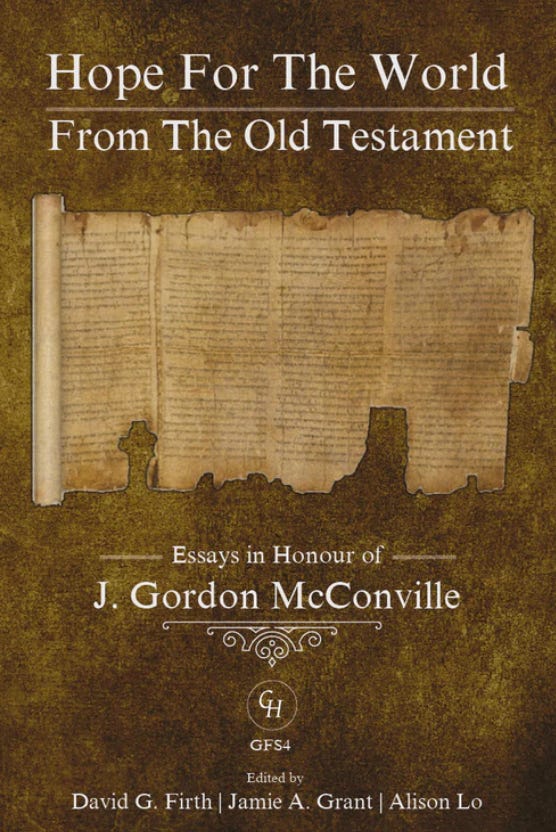
Gordon was a wonderful, gracious, and sharpening supervisor through my MA and PhD journeys. He is best known for his work on Deuteronomy and the Prophets (most recently, Isaiah), as well as working on Old Testament Theology themes such as power and being human.
Here’s the blurb:
Hope for the World from the Old Testament is a collection of essays offered in honour of Professor J. Gordon McConville on his 70th Birthday. Written by friends, colleagues and former doctoral students, this collection of essays reflects on the theme of hope in and from the Old Testament. In a world that so often struggles to find hope due to ever-present tension, disappointment and anxiety, how does the Old Testament encourage us to lift our eyes and see a better future, both here and now and in the end? With essays addressing a wide variety of Old Testament texts, from Genesis to Jeremiah to the Song of Songs, hope is to be found throughout the first testament—hope that challenges and changes our perspective on present reality.
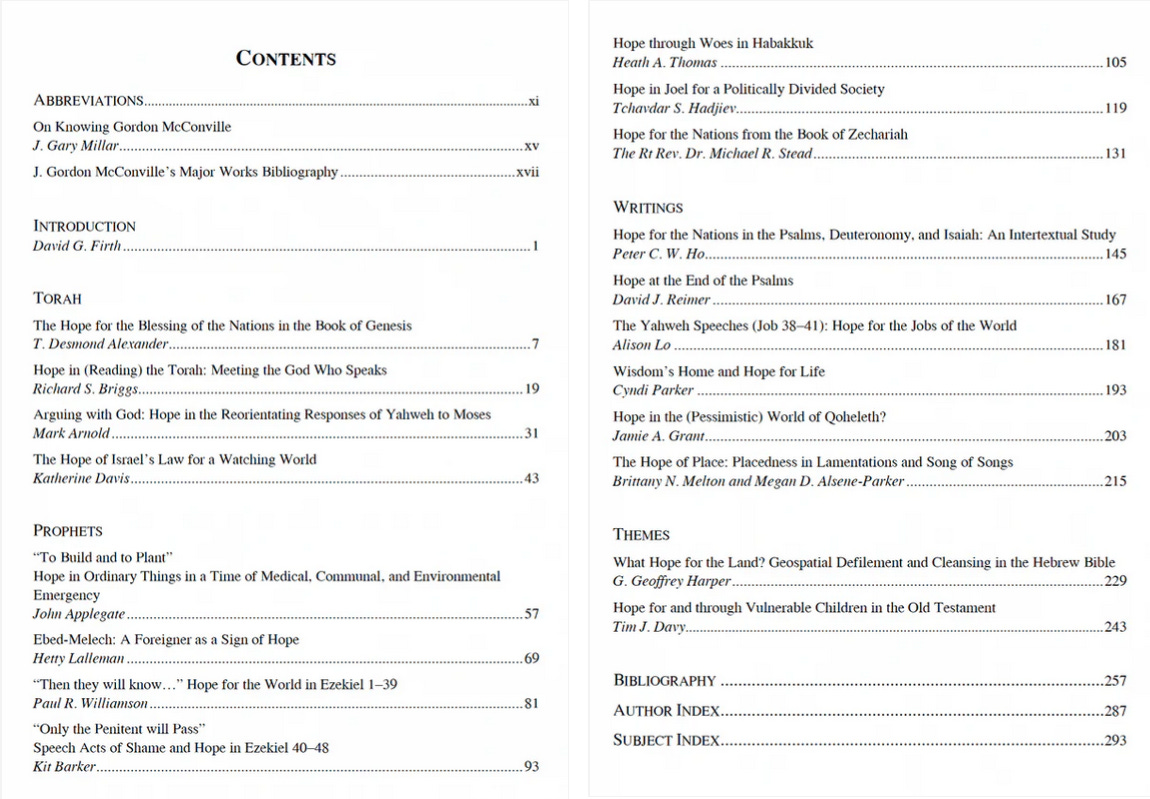
As you can see from the book’s contents page, there was no shortage of people wanting to be involved; a testament to how well-regarded Gordon is. Indeed, this is actually his second festschrift, following the 2013 volume A God of Faithfulness: Essays in Honour of J. Gordon McConville on his 60th Birthday (Bloomsbury, again edited by Alison and Jamie, but also by the late Gordon Wenham, who actually supervised Gordon McConville’s PhD.
For my contribution I wanted to use the opportunity to bring together work I’d been doing in both of my postgrad dissertations. My MA dissertation was a study of the ‘widow, orphan, and alien’ in Deuteronomy with a view to developing a PhD thesis looking at the orphan in the Old Testament. As I’ve shared about before, this morphed into a study of orphanhood in Job, which then became part of a chapter on poverty and justice in the final thesis, a missional reading of the book of Job.
I had been developing material for a long time on the different uses of the Hebrew term for orphan or fatherless, yatom, and wanted to pin this all down for the paper. I also wanted to look at these texts in the light of the conference’s theme: hope.
The final paper title is, ‘Hope for and through Vulnerable Children in the Old Testament.’
To get a sense of the chapter, here is part of the introduction:
The purpose of this essay is to explore the theme of “hope in the Old Testament” with a particular focus on those for whom life might have seemed the most hopeless: vulnerable children. By “vulnerable children” I am referring to children or young people in the OT whose lives are in some sense diminished or at risk. This could be through physical harm but equally could refer to economic or legal risk factors.
The majority of the study will be taken up with an examination of OT texts that feature the Hebrew term, יָתוֹם (yatom), usually rendered in English as “orphan” or “fatherless”. These figures are not, of course, the only vulnerable children depicted in the OT. Nevertheless, the ability to concentrate on one prominent subsection of vulnerable children does provide a focused way of looking at our topic and would provide a platform for further work on other groupings.
The study begins by defining the identity of the yatom and noting some initial observations about the frequency and distribution of the term’s use in the OT. It then highlights a number of categories into which these uses occur, offers some reflections on how the yatom texts help us to think about hope, and concludes with some implications for the ongoing work of the contemporary church in theologising about, for and with vulnerable children.
And to give you a sense of the content and flow of argument the overall structure of the chapter includes:
Identity, frequency and distribution of the yatom
Categories of the use of yatom
Divine perspectives on the yatom
General command to act justly
General command to provide
Grounds for blessing
Grounds or result of divine cursing/ punishment
Indictment of wickedness
Call to repentance
Human perspectives on the yatom
Lament over Yahweh’s seeming indifference to the wicked
Lament over one’s own sense of abandonment
Defence of one’s righteousness
Celebration of Yahweh and offer or means of hope
Dynamics of hope for and through the yatom
The hope of Yahweh’s commitments
The hope of extremity
The hope of lament
Summary, conclusion and implications
My hope with the chapter is that it will be a helpful reference point for scholars and students as they work on the theme of children-at-risk in the Bible, either as their primary focus or perhaps when they come across a ‘yatom text’ some other way, such as writing commentaries or exegetical papers. I hope it will illustrate the rich picture of the way the biblical writers feature the yatom in the Hebrew Scriptures. I hope it will show something of God’s deep care for all children, particularly those facing difficulties. I hope, too, practitioners will find it a helpful resource as they draw on Scripture to inform their work.
You can get hold of the volume in the usual places, including the publisher’s website: GlossaHouse.
Thanks for joining the journey and see you next week,
Tim
Congratulations on the publication! I look forward to reading all of the essays on a much needed and timely theme of hope.